

Why Parents Need to Know the Difference
When your teen is struggling in school, you may hear educators mention an IEP or a 504 Plan. These terms can feel overwhelming at first, but knowing the difference between them can make all the difference in how your child is supported. Both are legally binding plans designed to help students with disabilities succeed, yet they serve different purposes, follow different laws, and provide different types of support.
At Grayson Executive Learning, we often meet parents who feel uncertain about what their child truly needs. This guide will walk you through the basics of IEPs and 504 Plans, highlight the key differences, and show you how each might fit your child’s unique learning journey.
What Is an IEP?
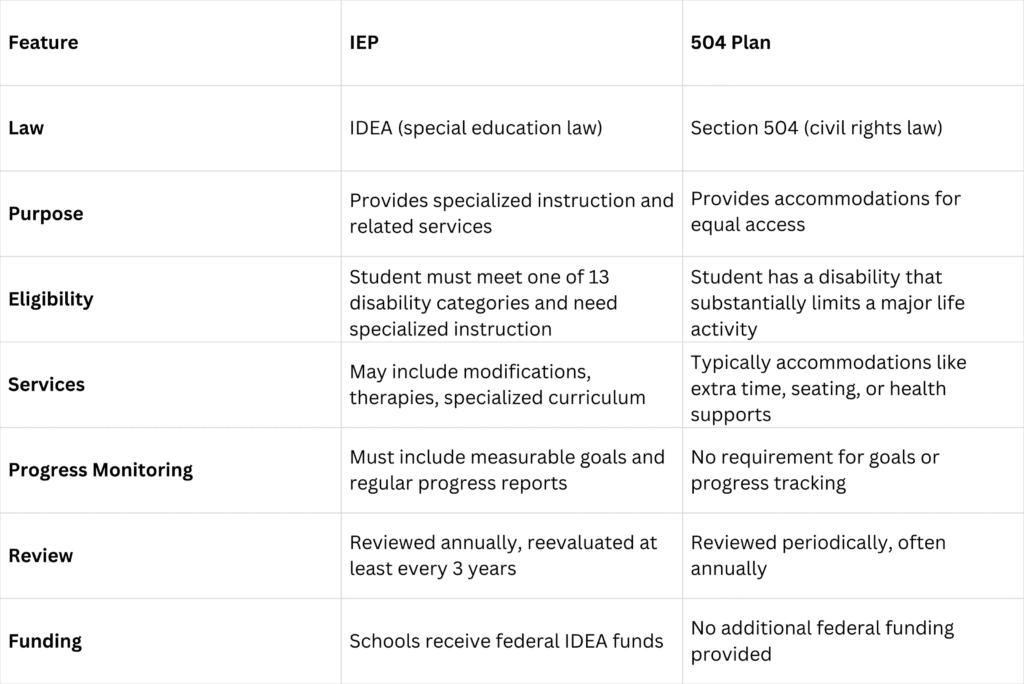
An Individualized Education Program (IEP) is a formal plan that provides specialized instruction and services for students whose disabilities significantly impact their ability to learn. Governed by the Individuals with Disabilities Education Act (IDEA), IEPs are detailed documents that:
- Include measurable annual goals and progress monitoring.
- Provide tailored services such as speech therapy, occupational therapy, or specialized reading instruction.
- Outline how often services are provided, who delivers them, and in what setting.
- Address modifications to curriculum when necessary.
To qualify for an IEP, a student must fall under one of 13 specific disability categories defined by IDEA, such as autism, ADHD under “Other Health Impairments,” emotional disturbance, or a specific learning disability. In addition, the disability must negatively affect academic or functional performance and require specialized instruction.
What Is a 504 Plan?
A 504 Plan falls under Section 504 of the Rehabilitation Act of 1973, a federal civil rights law designed to prevent discrimination against students with disabilities. Unlike an IEP, it does not provide specialized instruction. Instead, it ensures students have equal access to education through accommodations.
Examples of 504 Plan accommodations include:
- Extra time on tests and assignments.
- Preferential classroom seating.
- Permission for movement breaks.
- Assistive technology or audiobooks.
- Health-related adjustments, such as snack breaks for diabetes.
Eligibility is broader than for IEPs. A student qualifies if they have a physical or mental impairment that substantially limits one or more major life activities, such as reading, concentrating, or communicating.
Key Differences Between IEPs and 504 Plans
While both are designed to support students, there are important distinctions parents need to understand.
How Parents Are Involved
Both plans require parent involvement, but the level of collaboration is different.
- IEP: Parents are key members of the IEP team, which also includes general and special education teachers, a school administrator, and specialists. Parents must provide written consent for evaluations and services, and they can challenge school decisions through formal dispute resolution if needed.
- 504 Plan: The process is less formal, but parents are still important advocates. Teams usually include teachers, administrators, and a 504 coordinator. Parents must give consent for evaluations and can request revisions if accommodations are not being implemented properly.
When Might Your Teen Need One?
- If your teen requires specialized instruction to make academic progress, an IEP is usually the right fit. For example, a student with dyslexia who needs structured reading intervention would likely benefit from an IEP.
- If your teen is able to succeed in general education but needs accommodations to remove barriers, a 504 Plan may be sufficient. For example, a student with ADHD who needs extended test time and movement breaks might qualify for a 504.
Remember, a student cannot have both at the same time. If they qualify for an IEP, that plan takes precedence. However, students may transition between plans as their needs evolve.
Common Misconceptions Parents Hear
- “IEPs are only for severe disabilities.” In reality, many students with ADHD, mild autism, or learning disabilities qualify if specialized instruction is needed.
- “504 Plans are easier to get.” Documentation is still required, and schools must prove that a disability substantially limits major life activities.
- “You have to pick one forever.” Plans can change. As students grow, they may move from a 504 to an IEP or vice versa.
Why This Matters for Long-Term Success
Understanding these plans is about more than paperwork; it shapes how your teen experiences school. Research shows that structured supports can improve not only academic outcomes but also emotional well-being. Students who feel supported are more likely to stay engaged, advocate for themselves, and build resilience that carries into adulthood.
How Grayson Executive Learning Supports Families
At Grayson Executive Learning, we know how confusing this process can be. Our academic and executive function coaching helps families navigate IEPs and 504 Plans, while giving students the tools to build independence, self-advocacy, and long-term success.
Whether your child needs help staying organized, managing stress, or developing study strategies, our one-on-one coaching programs are designed to support them in school and beyond.
If you are wondering whether your teen needs an IEP, a 504 Plan, or just extra guidance, we are here to help you every step of the way.